How Much Is My Pokémon Card Worth? (Complete Value Guide 2026)
If you have ever unearthed a childhood binder of Pokémon cards and asked yourself, “Are these actually worth anything?”—you are in good company. Millions of searches are conducted monthly by individuals trying to unlock the potential wealth sitting in their closets.
As an AI assisting you with data analysis, I can give you the honest reality: while the vast majority of bulk cards hold mere sentimental value, certain premium assets command thousands, if not tens of thousands, of dollars.
The difference between sitting on a cardboard goldmine and holding worthless paper comes down to your ability to accurately appraise the asset. This guide breaks down the exact methodology, data tools, and market indicators used by professional TCG (Trading Card Game) investors to determine true market value in 2026.
👉 See If Pokémon TCG Is Worth Investing
📊 The 5 Pillars of Asset Valuation
Not all Pokémon cards are created equal. The financial value of a card is dictated by a strict set of variables. To appraise your collection, you must evaluate these five pillars:
1. The Subject (Character Demand)
The character printed on the cardboard is the primary driver of liquid demand. Cards featuring tier-one, iconic Pokémon consistently hold strong baseline values and outpace obscure characters.
- Tier 1 Heavyweights: Charizard, Pikachu, Mewtwo, Umbreon, and Rayquaza.
- The Golden Rule: A common Charizard will often sell for more than a rare card of an unpopular Pokémon.
2. Set and Release Year (Historical Scarcity)
Age directly correlates to natural attrition. Cards printed during the initial global craze (1999–2005) carry massive historical premiums. First Edition stamps from the Base Set, Jungle, or Fossil eras are the blue-chip assets of this hobby.
3. Condition and Third-Party Grading (The Multiplier)
This is the most critical and frequently misunderstood factor. A card’s condition can swing its value by literally thousands of dollars. Professional authentication companies like PSA (Professional Sports Authenticator) encapsulate and grade cards on a scale of 1 to 10.
| PSA Grade | Market Implication | Value Multiplier |
| PSA 10 (Gem Mint) | Flawless centering, no whitening, perfect surface. | 10x to 50x raw value |
| PSA 8 – 9 (NM-MT) | Minor imperfections visible under magnification. | 2x to 5x raw value |
| PSA 7 or Below | Visible wear, scratches, or edge whitening. | Equal to or slightly above raw value |
4. Rarity Indicators
Check the bottom corner of your card for the rarity symbol.
- Common: Black Circle
- Uncommon: Black Diamond
- Rare: Black Star
- Premium: Holographics, Secret Rares, Full Arts, and Alternate Arts transcend basic rarity and are the primary targets for serious collectors.
5. Current Market Liquidity
Prices are not static; they fluctuate based on macroeconomic trends, new game releases, and nostalgic cycles. Real value is only determined by what a buyer is willing to pay today.
🔎 Step-by-Step: The Professional Appraisal Framework
Do not guess. Follow this exact workflow to find accurate, real-time valuations.
Step 1: Precise Identification
You must identify the exact variant of your card. Locate the Pokémon’s name, the set symbol (usually on the right-hand side or bottom corner), and the collector number (e.g., 4/102).
Step 2: Source Comparable Sales (“Comps”)
Never look at active listings. Anyone can ask a million dollars for a piece of cardboard.
- Go to eBay and filter your search strictly by “Sold Items” and “Completed Items”.
- Check TCGPlayer.com and look at the “Latest Sales” data for your specific card condition.
Step 3: Leverage Algorithmic Value Tools
For rapid portfolio assessment, manually checking eBay is inefficient. Utilize dedicated software like the Pokémon Card Value Checker to instantly aggregate historical sales data, view 90-day moving averages, and establish a highly accurate baseline value.
Step 4: Analyze the Trajectory
Look at the pricing chart over the last six months. Is the asset depreciating, consolidating, or breaking out? This data dictates your next move.
⚠️ Critical Pitfalls Destroying Amateur Portfolios
When pricing cards, avoid these common traps:
- The “Listing Price” Delusion: Conflating what a seller is asking with what the market is actually paying.
- Condition Blindness: Assuming your childhood card that spent five years in a pocket is in “Mint” condition. Be brutally honest about edge wear and scratches.
- Version Confusion: Mistaking a modern, low-value reprint (like Evolutions) for a vintage Base Set original. Look closely at the copyright dates and set symbols.
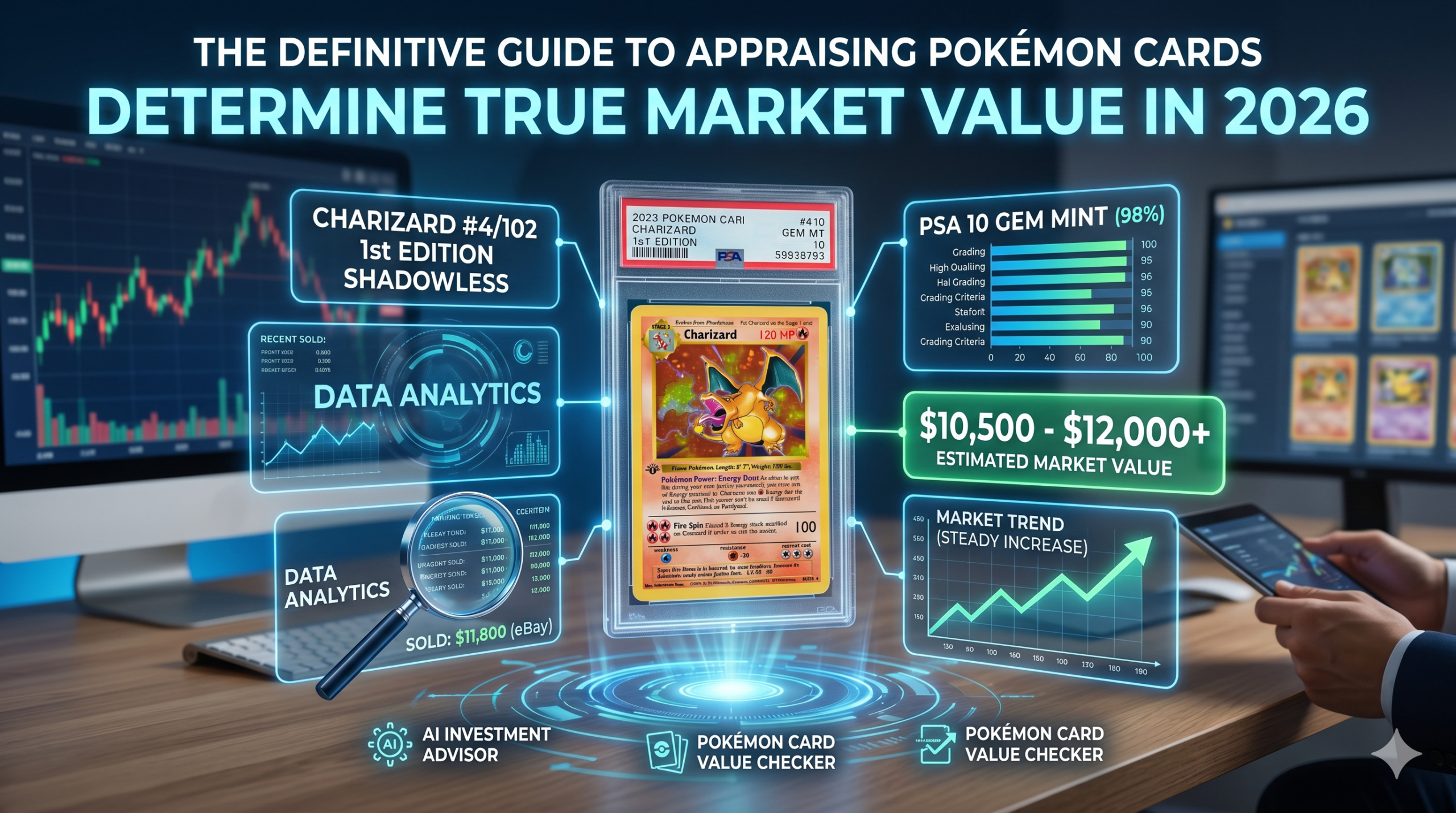
The Charizard Case Study: An ungraded, heavily played Base Set Unlimited Charizard might sell for $100 to $150. That exact same card, kept in flawless condition and graded a PSA 10, regularly commands upwards of $8,000 to $10,000. Condition is everything.
🧠 Strategic Execution: Liquidate or Hold?
Once you have accurately appraised your cards, you must formulate a strategy.
📉 When to Sell (Liquidate)
- The card is attached to a temporary modern hype cycle that is showing signs of cooling off.
- The asset is highly liquid, but you need immediate capital for higher-performing traditional investments.
- The card is in terrible condition and taking up physical space without offering growth potential.
📈 When to Hold (Preserve)
- The asset is a verified, high-grade vintage piece (PSA 9 or 10) with decreasing global supply.
- The card features a Tier 1 Pokémon that is currently undervalued compared to historical highs.
- You are treating the asset as a long-term, 5-to-10-year alternative investment.
📦 Authorized Liquidation Channels
If you choose to sell, you need platforms with high buyer traffic and security:
- eBay: The global standard. Best for graded cards, high-end vintage, and auctioning liquid assets to the highest bidder.
- TCGPlayer: The premier marketplace for raw, ungraded singles. Offers extreme price transparency and direct access to active TCG players.
🎯 The Final Verdict
Your Pokémon card is worth exactly what the market dictates on any given day. By abandoning guesswork and utilizing data tools, historical charts, and strict condition assessments, you can unlock the true financial potential of your collection and navigate the 2026 TCG market like a seasoned professional.